Showing posts with label Classical. Show all posts

Vivaldi - Virtuoso Cantatas; Heroes: opera arias (Philippe Jaroussky)

Vivaldi - Virtuoso Cantatas; Heroes: opera arias (Philippe Jaroussky)
Classical | EAC Rip | FLAC, IMG+CUE, LOG | Covers | 2cd, 580.36 MB

Philippe Jaroussky (born 13 February 1978 in Maisons-Laffitte, France)[1] is a French sopranist countertenor. He began his musical career with the violin, winning an award at the Versailles conservatory and then took up the piano before turning to singing. He is noted for a virtuosic coloratura technique and for compelling and enlivened interpretations of baroque cantatas and operas.
Jaroussky was inspired to sing by the Martinique-born countertenor Fabrice di Falco.[2] He received his diploma from the Early Music Faculty of the Conservatoire de Paris. Since 1996, he has studied singing with Nicole Fallien.[3] He has formed his own ensemble called Artaserse, and also often performs with the Ensemble Matheus under Jean-Christophe Spinosi and with L'Arpeggiata under Christina Pluhar.


Vivaldi - Virtuoso Cantatas (Philippe Jaroussky, Ensemble Artaserse) [2005]
EAC Rip | FLAC, IMG+CUE, LOG | Covers
Virgin | 7243 5 45721 2 8 | 1cd, 321.35 MB

This exciting recording of Vivaldi cantatas for solo voice and instrumental ensemble is one of the more compelling releases of the year to date! While the music of the glorious Venetian Antonio Vivaldi is well known, especially the standard repertoire `The Four Seasons' and the choral works and chamber works - even some operas - the cantatas are rarely performed and this CD of his best ones should change that.
Philippe Jaroussky is yet another fine countertenor who is rather recent on the scene. With the growing popularity of musicians courageous and gifted enough to become successful in the countertenor repertoire (just pause for a moment and think of the significant number a star quality countertenors on the stages today), the numerous pieces for this range of voice continue to appear. Vivaldi's cantatas are refined, beautifully embellished, demanding consummate artistry of not only the high hurdles for the voice but also for the accompanying forces. Jaroussky seems to have endless breath, singing the long extended lines with total ease. His embellishments alter with each da capo as to the period born! This is a voice a great power and warmth and one that feels married to the texts.
Providing brilliant collaboration is the Ensemble Artaserse and period instruments. The variety of color is awe-inspiring and the technique of these unique musicians is impeccable. In their solo portions they produce a richly elegant - yes, Venetian sound. And in tandem with Jaroussky the complete effect is one of single purpose, line, and harmony.
This is a new CD to treasure and the sampling is generous. For this reviewer this is a new repertoire to explore and it would be difficult to imagine forces better suited to these treasures than those on this CD. Highly recommended. Grady Harp, April 05
By Grady Harp (Los Angeles, CA United States)


Vivaldi – Heroes: opera arias (Philippe Jaroussky, Jean-Christophe Spinosi) [2006]
Virgin | 00946 363414 2 2| 1cd, 259.01 MB

I just recently discovered Jaroussky and and am beyond thrilled. I've never given countertenors much thought beyond an occasional Vivaldi opera but having these pulled together in one album changed it for me, all because of Philippe's incomparable voice and an upper registry clarity to make sopranos green with envy. In a matter of days, I've purchased several of his albums as gifts and found it funny that my two colleagues (with drastically different music tastes, one never having listened to opera before!) were listening to him with the same enthusiasm as I. Can not wait to hear more from him and hope that he'll tour in the MidAtlantic US soon.
By VictoriaPB "Victoria" (Reston, VA)


  • Digg
  • Del.icio.us
  • StumbleUpon
  • Reddit
  • RSS

Bruno Maderna - The Last Concert - Bartok, Schoenberg: Piano Concertos

Bruno Maderna - The Last Concert - Bartok, Schoenberg: Piano Concertos - Alfred Brendel (piano)
EAC (FLAC, IMG+CUE, LOG) | Scans 300/600 dpi | 1CD, 276 MB + 19,5 MB (.rar 3% rec.)
Classical | Stradivarius STR 10071, Italy 1993 | (live recording)

On the 5th November 1973, in London, Bruno Maderna conducted his last concert. He died suddenly a few days later in his home town of Darmstadt; he knew he was dying, still the end came far earlier than even the most pessimistic had imagined. On his desk at home, they found untouched the score of Debussy's 'Pelleas et Melisande' which he had planned to conduct in Holland shortly afterwards.
The concert was broadcast by the BBC throughout Europe, as if to confirm the personal philosophy that Maderna had tried to communicate during his life as a conductor and a composter, a belief in a life open to every sort of stimulus and abounding in new possibilities.

Read More...


Bruno Maderna - The Last Concert
Royal Festival Hall, London, BBC Symphony Orchestra, piano: Alfred Brendel
Conversation with George Stone and Alan Stout (abridged version) from WEFM Radio of Chicago on January 23, 1970.

01. Bela Bartok / Piano Concerto 1 - 1 Allegro moderato [09:37]
02. Bela Bartok / Piano Concerto 1 - 2 Andante [09:05]
03. Bela Bartok / Piano Concerto 1 - 3 Allegro molto [07:31]
04. Arnold Schoenberg / Piano Concerto op 42 [20:44]
05. A conversation with Bruno Maderna [25:05]

Until today many listeners of classical music still won't believe that Alfred Brendel has ever played (or even recorded) works by Bartok (e.g. the Sonata for two Pianos with Charlotte Zelka) or some other 'modern' composers, except perhaps Schoenberg. Unfortunately this suspicions got more or less confirmed by Brendel's former record label Turnabout/Vox, because his early Bartok recording has not been included in the CD re-releases so far.
In fact, however, he never recorded any of the Bartok concertos, and since the early 1970s he has nevermore played these works in concert. This live recording represents a rare document of his discography.

  • Digg
  • Del.icio.us
  • StumbleUpon
  • Reddit
  • RSS

Beethoven: Symphony no. 9 in D minor, op. 125 (The Solti Collection)

Beethoven: Symphony no. 9 in D minor, op. 125 (The Solti Collection) [XRCD24]
Chicago Symphony Orchestra & Sir Georg Solti
XLD Rip - FLAC, CUE, LOG --> 386.33 MB | Full Booklet (PDF) --> 12.41 MB
Decca/London VICJ-025-4382 (Japan) | 76:30 | Classical | 1972, 2008 (XRCD release)

Sir Georg Solti, KBE (pronounced /ˈdʒɔrdʒ ˈʃɒlti/; 21 October 1912 – 5 September 1997) was a Hungarian-British orchestral and operatic conductor. He was a major classical recording artist, holding the record for having received the most Grammy Awards, having personally won 31 as a conductor, including the Grammy Lifetime Achievement Award. In addition to his recordings he is probably best known for leading the Chicago Symphony Orchestra from 1969-91. He is widely regarded as one of the greatest conductors of the second half of the 20th century.

Read More...


Tracklist:

Symphony no. 9 in D minor, op. 125
1. Allegro ma non troppo, un poco maestoso (17:39)
2. Molto vivace (13:57)
3. Adagio molto e cantabile (19:46)
4. Presto (24:59)

Total timing: 76:30

Music composed by Ludwig van Beethoven (1770-1827)

Chicago Symphony Orchestra
(Chorus director: Margaret Hillis)
Sir Georg Solti

Recording location: Krannert Center, University of Illinois, May 1972


  • Digg
  • Del.icio.us
  • StumbleUpon
  • Reddit
  • RSS

Tchaikovsky: Symphonies, Orchestral Works (Claudio Abbado) [2002]

Tchaikovsky: Symphonies, Orchestral Works (Claudio Abbado) [2002]
EAC Rip | FLAC, IMG+CUE, LOG | Covers | 6cd, 1.33 GB
Classical | Label: Sony

Claudio Abbado is one of the leading conductors of the late twentieth and early twenty-first centuries. He has held a number of prestigious posts, any one of which would be a crowning achievement for a conductor, and his musical presence in both concert and recordings has left an undeniable legacy of excellence. His family traces its roots to a prominent Moorish family expelled from Spain in 1492 and is said to include the architect of the Alhambra. His father was Michelangelo Abbado, a violinist and teacher who gave both Claudio and his brother, Marcello Abbado, their first piano and music lessons (Marcello has gone on to become a pianist and composer). Claudio was educated at the Milan Conservatory, graduating in 1955 with a certificate in piano. While a student there, he also studied conducting with Antonio Votto. In 1955, he studied piano with Friedrich Gulda in Salzburg, and then (from 1956-1958) attended Hans Swarowsky's conducting classes at the Vienna Academy of Music. In 1958, he made his conducting debut in Trieste, and won the Koussevitzky Competition at Tanglewood. This led to his engagement in several provincial opera houses and orchestras, as well as a teaching position at Parma Conservatory. After winning the 1963 Dimitri Mitropoulos Prize, he was awarded a five-month position on the staff of the New York Philharmonic, with which he made his American professional debut on April 7, 1963. The year 1965 marked his debut with the Vienna Philharmonic at the Salzburg Festival, but more so for his return to his hometown of Milan to conduct at La Scala. He would conduct there again in 1967, become the company's resident director in 1968, and be named music director in 1971. Abbado was credited with raising the performing standards at La Scala, and for broadening its repertory. He also organized its orchestral players into the Orchestra della Scala, whose performances of works by such composers as Schoenberg, Nono, Ligeti, Stockhausen, and Berio brought Abbado special acclaim as an interpreter of modern works. In 1971, he was appointed principal conductor of the Vienna Philharmonic. Soon after, he formed a relationship with the London Symphony Orchestra, of which he became principal conductor in 1979, and finally music director, a post he retained until 1988. Other activities during this period included the founding of the European Community Youth Orchestra, the Chamber Orchestra of Europe, and the Gustav Mahler Youth Chamber Orchestra. For the period 1982-1986, Abbado served as principal guest conductor at the Chicago Symphony Orchestra, after which he was appointed music director of the Vienna State Opera. The Viennese further honored him by appointing him general music director of the city. During his tenure, he founded (1988) the Wien Modern music festival, which has now grown to encompass all forms of contemporary art. Abbado succeeded Herbert von Karajan as music director of the Berlin Philharmonic in 1989. In 1991, he relinquished his position at the Vienna State Opera, but he has maintained a presence in the city by founding the annual Vienna prize for young composers. In 1994, he succeeded to another post once held by Karajan, namely the directorship of the Salzburg Easter Festival. Following a bout with cancer in 2000, Abbado formed the Lucerne Festival Orchestra in 2003 with the orchestra's artistic and executive director, Michael Haefliger. Though Abbado briefly suspended his activities in 2007, he took up the baton again after a two month absence. Abbado is an exciting conductor who relishes the beauty of tone. His extensive discography includes the complete symphonic works of Mahler, Schubert, Ravel, Tchaikovsky, Mendelssohn, and Beethoven, and dozens of other recordings.

Read More...


Tracklisting:
CD1:
Symphony No.1 in G minor, Op. 13 "Winter Dreams"
1. I. Allegro tranquillo
2. II. Land of Desolation, Land of Mists - Adagio cantabile ma non tanto
3. III. Scherzo. Allegro scherzando giocoso
4. IV. Finale. Andante lugubre - Allegro moderator - Allegro maestoso - Allegro vivo
The Nutcracker, Op 71a
1. I. Ouverture. Allegro giusto
2. II. Danses caracteristiques - a. Marche. Tempo di marcia viva
3. II. Danses caracteristiques - b. Danse de la Fee Dragee. Andante non troppo
4. II. Danses caracteristiques - c. Danse Russe Trepak. Molto vivace
5. II. Danses caracteristiques - d. Danse Arabe. Allegretto
6. II. Danses caracteristiques - e. Danse Chinoise. Allegro moderato
7. II. Danses caracteristiques - f. Danse des Mirlitons. Moderato assai
8. III. Valse des Fleurs. Tempo di valse
CD 2:
The Tempest, Op. 18 (Symphonic Fantasy after Shakespeare)
1. Andanto con moto – Allegro moderato – Andante con moto
Symphony No. 2 in C minor, Op. 17 "Little Russian"
2. I. Andante sostenuto - Allegro vivo
3. II. Andantino marziale, quasi moderato
4. III. Scherzo. Allegro molto vivace
5. IV. Finale. Moderato assai - Allegro vivo
CD3:
Symphony No. 3 in D Major, Op. 29 "Polish"
1. I. Introduzione. Moderato assai (Tempo di marcia funebre) – Allegro brilliante
2. II . Alla Tedesca. Allegro moderato e semplice
3. III. Andante. Andante elegiaco
4. IV. Scherzo. Allegro vivo
5. V. Finale. Allegro con fuoco (Tempo di Polacca)
“1812” Overture, Op. 49
6. Largo – Andante - Allegro giusto
7. Largo - Allegro vivace
CD4:
Symphony No. 4 in F minor, Op. 36
1. I. Andante sostenuto - Moderato con anima – Moderato assai, quasi Andante – Allegro vivo
2. II. Andantino in modo di canzona
3. III. Scherzo. Pizzicato ostinato. Allegro
4. IV. Finale. Allegro con fuoco Romeo and Juliet (Fantasy Overture after Shakespeare)
5. Andante non tanto quasi Moderato – Allegro giusto – Moderato assai
CD5:
Symphony No. 5 in E minor, Op. 64
1. I. Andante - Allegro con anima
2. II. Andante cantabile, con alcuna licenza – Moderato con anima – Andante mosso – Allegro non troppo – Tempo I
3. III. Valse. Allegro moderato
4. IV. Finale. Andante maestoso - Allegro vivace – Molto vivace – Moderato assai e molto maestoso – Presto
The Voyevoda, Op. 78 (Symphonic Ballad)
5. Allegro vivacissimo – Moderato – Allegro vivacissimo
CD6:
Symphony No. 6 in B minor, Op. 74, "Pathetique"
1. I. Adagio - Allegro non troppo – Andante – Moderato mosso – Andante – Moderato assai – Allegro vivo – Andante con prima – Andante mosso
2. II. Allegro con grazia
3. III. Allegro molto vivace
4. IV. Finale. Adagio lamentoso – Andante Marche Slave, Op. 31
5. Moderato in modo di marcia funebre – Piu mosso. Allegro – Andante molto maestoso – Allegro risoluto


  • Digg
  • Del.icio.us
  • StumbleUpon
  • Reddit
  • RSS

Offenbach: Les Contes d'Hoffmann [1992]

Offenbach: Les Contes d'Hoffmann (Jeffrey Tate, Francisco Araiza, Jessye Norman, Anne Sofie von Otter) [1992]
EAC Rip | FLAC, IMG+CUE, LOG | Covers | 3cd, 717.48 MB
Classical | Label: DECCA

It would be hard to find an opera in any area of the repertory that presents so many textual problems as Les conies d'Holfmann, largely stemming from the fact that the composer died four months before the premiere early in 1881, leaving the score incomplete. The traditional text, bringing in extra material, much of it unauthentic, and leaving out a lot, was only established this century. Arthur Hammond with the Carl Rosa Company was a pioneer in attempting to sort out a more acceptable text, and his work formed the basis of the English National Opera production at the Coliseum and also the Richard Bonynge recording for Decca. Since then the discovery of no less than 1,250 autograph pages allowed Fritz Oeser to produce his monumental edition, as used extensively in the Cambreling recording for EMI (12/88 —nla). That extended the piece to Wagnerian lengths, but since then still more material has been uncovered, involving some 350 more manuscript pages, which have been researched by Michael Kaye to form the basis for his new edition published by Schott in 1991. Though the edition was not complete at the time the Dresden recording sessions were held (June 1987-June 1989), this new Philips set is based on his material, aiming in Jeffrey Tate's words to come "as close as we can to envisage the score and the drama that Offenbach conceived before his untimely death".
One big difference here from the complete Oeser edition, as presented by Cambreling, is that dialogue replaces all the recitatives written by Ernest Guiraud. The Bonynge text similarly replaces recitative with spoken dialogue, but this new set uses far more. As with Oeser the Prologue is more extended, showing the transformation of the Muse into Nicklausse, with extra material in the Olympia and Antonia acts too, much as the striking trio for Hoffmann, Nicklausse and Coppelius. Also, Tate points out that "the Giulietta act contains music that shows conclusively that Offenbach would have wanted a single voice to embody all of Hoffmann's female infatuations". A fascinating illustration of that comes in the jaunty couplets, "L'amour lui dit: la belle", leading into exchanges and a duet reprise with Hoffmann. It is a jolly little piece, close in style to earlier Offenbach, which in its lightness and use of high coloratura radically alters one's conception of the character of the Venetian femme fatale. Needless to say, Cheryl Studer, has no problems here over high coloratura, but in context it does tend to take you by surprise.

Read More...


Tracklisting:
CD1
1. Prélude. Acte I. Introduction: Glou!... (les esprits invisibles)
2. La vérité, dit-on, sortait d'un puits (la Muse, les esprits invisibles)
3. Dialogue: Allons! mes enfants, préparez cette sale! (Lindorf, Andrès)
4. Voyons: Pour Hoffmann! (Lindorf)
5. Récit: Deux heures devant moi (Lindorf)
6. Vive Dieu! (Nathanael, les étudiants, Hermann…)
7. Bonjour amis! (Hoffmann, Nicklausse…)
8. Chanson et Scène: Il était une fois à la cour d'Eisenach (Hoffmann, les étudiants…)
9. Finale: Peuh! cette bière est detestable! (Hoffmann, les étudiants…)
10. Duo: Et par où votre diablerie (Hoffmann, Lindorf, Nicklausse…)
11. Je vous dis, moi, qu'un malheur me menace! (Hoffmann, Lindorf…)
12. Entr'acte
13. Acte II. OLYMPIA. Là! charmante! (Spalanzani, Hoffmann)
14. Allons! courage et confiance (Hoffmann, Nicklausse)
15. Une poupée aux yeux d'émail (Nicklausse, Hoffmann)
16. Récit et Trio: C'est moi, Coppélius (Coppelius, Nicklausse, Hoffmann)
17. Je me nomme Coppélius (Coppelius, Hoffmann, Nicklausse)
18. Serviteur (Hoffmann, Coppelius, Nicklausse)
19. Tout est prêt (Spalanzani, Hoffmann)
20. Choeur et Couplets: Non, aucun hôte vraiment
21. Couplets: Les oiseaux dans la charmille (Olympia, les invités)
22. Ah! mon ami, quel accent (Hoffmann, Nicklausse, Spalanzani…)
CD2
01. Scène et Romance: Ils se sont éloignés, enfin! (Hoffmann, Olympia)
02. Tu me fuis? (Hoffmann, Nicklausse, Coppélius)
03. Voici les valseurs (Spalanzani, Cochenille, Hoffmann...)
04. Acte III. ANTONIA. Entr'acte. Romance: Elle a fui, la tourterelle! (Antonia)
05. Dialogue: Malheureuse enfant! (Crespel, Antonia, Frantz)
06. Couplets: Jour et nuit, je me mets en quatre (Frantz)
07. Dialogue: Voilà ce brave Frantz (Hoffmann, Franrz, Nicklausse)
08. Romance: Vois sous l'archet frémissant (Nicklausse)
09. Dialogue: Ah! tu doutes de tout! (Hoffmann, Nicklausse, Antonia)
10. Pourtant, ô man fiancée (Hoffmann, Antonia)
11. C'est une chanson d'amour (Antonia, Hoffmann)
12. Dialogue: Qu'as to donc? Tu souffres? (Hoffmann, Antonia, Crespel, Frantz)
13. Trio: Pour conjurer le danger (Miracle, Hoffmann, Crespel, Antonia)
14. Dialogue - Mélodrame: Ne plus chater!... Voilà son arrêt! (Hoffmann, Antonia)
15. Trio: Tu ne chanteras plus? (Miracle, Antonia)
16. Ta mère? Oses-tu l'invoquer? (Miracle, la voix, Antonia)
17. Finale: Mon enfant! Ma fille! (Crespel, Antonia, Hoffmann, Nicklausse, Miracle)
CD3
01. Acte IV. GIULIETTA. Entr'acte et [Barcarolle]
02. Messieurs, silence! (Hoffmann)
03. Belle nuit, o nuit d’amour (Nicklausse, Giulietta, les gondoliers)
04. Récit et Couplets: Et moi, ce n'est pas là ce qui m'enchante (Hoffmann, les invités)
05. A merveille, madame (Schlemil, Giulietta, Dapertutto, Nicklausse, Hoffmann)
06. Chanson: Tourne, tourne, miroir (Dapertutto)
07. Dialogue: Charmante! (Dapertutto, Giulietta, Schlemil"
08. Giulietta, palsembleu! (les invités, Hoffmann, Schlemil, Dapertutto...)
09. L'amour lui dit: la belle, vos yeux étaient fermés! (Giulietta, Hoffmann, Schlemil...)
10. Tiens, mes cartes! (Hoffmann, Nicklausse, Pitchinaccio...)
11. Morbleu! (Schlemil, Dapertutto, Pitchinaccio)
12. Il a ma clé (Giulietta, les gondoliers, Nicklausse, Hoffmann, Schlemil)
13. Duo: Ton ami dit vrai (Giulietta, Hoffmann)
14. Romance: O Dieu, de quelle ivresse (Hoffmann)
15. Jusque là, cependant (Giulietta, Hoffmann)
16. Dialogue - Mélodrame: La voilà, donc (Giulietta, Dapertutto, Hoffmann)
17. Acte V. STELLA. Folie! Oublie tes douleurs! (les étudiants)
18. Dialogue: Voilà, mes amis (Hoffmann, Nathanael, Hermann...)
19. Pour le coeur du Phryné (Hoffmann, les etudiants)
20. Dialogue - Finale - Apothéose: Arrière, tous (la Muse, tous)

Performers:
Hoffmann – Francisco Araiza
Lindorf/ Coppélius/ Dapertutto/ Miracle – Samuel Ramay
Spalanzani – Riccardo Cassinelli
Crespel – Boris Martinovitch
Peter Schlemil – Jean-Luc Chaignaud
Andrés/ Cochenille/ Pitichinaccio/ Frantz – Georges Gautier
Luther – Rolf Tomaszewski
Nathanaël – Peter Menzel
Hermann – Jürgen Hartfiel
Olympia – Eva Lind
Antonia – Jessye Norman
Giulietta – Cheryl Studer
Nicklausse/La Muse – Anne Sofie von Otter
La voix de la mère d’Antonia – Felicity Palmer
Rundfunkchor Leipzig
Staatskapelle Dresden
Conductor - Jeffrey Tate

  • Digg
  • Del.icio.us
  • StumbleUpon
  • Reddit
  • RSS

Rossini: Armida (Riccardo Frizza, Renee Fleming) [2010]

Rossini: Armida (Riccardo Frizza, Renee Fleming) [2010]
NTSC 16:9 (720x480) VBR Auto Pan&Scan | Italiano (LinearPCM, 2 ch), (DTS, 6 ch)
4,20+5,85 Gb (DVD5+DVD9)

Classical | Label: DECCA | Sub: English, Francais, Deutsch, Espanol, Chinese | 183 min

Renée Fleming continues her reign as `Queen of the MET', starring in a bel canto rarity specially staged for her - a showcase for her extraordinary vocal virtuosity as well as one of the most beautiful voices of our time. This four-hour bel canto extravaganza is presented here on 2 DVDs. In addition to the great prima donna title role, Armida uniquely features no fewer than six tenor roles, here led by the acclaimed young American tenor Lawrence Brownlee(previously featured on the DG DVD of the Met's La Cenerentola.)In Mary Zimmerman's magical new production, supported by striking sets and colorful costumes and a fully-staged ballet, the `real world' of the Crusaders and the fantastical realm of Armida's enchanted island are clearly contrasted. Of Renée Fleming's performance, the The Opera Critic said: "The beautiful singing and appearance of Fleming make this an event worth seeing... She was especially brilliant in her long final scene which calls for rich legato singing as well as flashy ornamentation".

Read More...


Performer:

Goffredo - John Osborn
Eustazio - Yeghishe Manucharyan
Armida - Renée Fleming
Idraote - Peter Volpe
Gernando - Barry Banks
Rinaldo - Lawrence Brownlee
Astarotte - Keith Miller
Ubaldo - Kobie van Rensburg
Carlo - Barry Banks
Love - Teele Ude
Revenge - Isaac Scranton
Ballet Rinaldo – Aaron Loux
Violin Solo – David Chan
Cello Solo – Rafael Figueroa
The Metropolitan Opera Orchestra, Chorus and Ballet
Conductor – Riccardo Frizza

  • Digg
  • Del.icio.us
  • StumbleUpon
  • Reddit
  • RSS

Mozart: Die Entfuhrung aus dem Serail (Gustav Kuhn) [2005]

Mozart: Die Entfuhrung aus dem Serail (Gustav Kuhn) [2005]
NTSC 4:3 (720x480) VBR | Deutsch (LinearPCM, 2 ch) | 7,49 Gb (DVD9)
Classical | Label: Art Haus | Sub: Deutsch, English, Espanol | 140 min

Glyndebourne's production of Mozart's opera looks and sounds ravishing. The airy sets and gorgeous costumes set a frame for a superb ensemble cast to give of their very best. Top of the list has to be Valerie Masterson's Constanze. She sang the part for her Sadlers Wells Opera debut back in the early 1970s and then developed her interpretation over the next ten years. Here she gives an object lesson in singing, characterisation and stagecraft. She looks as good as she sounds and that is saying a great deal. A figure of simple dignity, she fills out the character of Constanze with great skill and she sings like an angel, plumbing the depths of "Traurigkeit" with wonderful expression and feeling, and then capping that with a fiery, confident and thrilling "Martern alle Arten". She sings gloriously in ensemble and duet. This is a great performance from a great British soprano and should not be missed. Why she was not more recorded or filmed is one of the mysteries of the record industry, so make the most of her performance here - it is wonderful. You can also catch her artistry on DVDs of the ENO's Xerxes and Julius Caesar, and very early in her career in the D'Oyly Carte Mikado. The rest of the cast is excellent: Ryland Davies as a fluent Belmonte (who looks good with Masterson as a convincing young couple); Lillian Watson, a dream as Blondchen; Willard White, a wonderful Osmin and James Hoback as a college-boy Pedrillo. Conducting is loving and expressive but above all don't miss this record of one of the very best sopranos to have graced our stages giving of her very best in this most testing of parts. Masterful Masterson!

Performer:
Belmonte - Ryland Davies
Constanze - Valerie Masterson
Blonde - Lillian Watson
Osmin - Willard White
Pedrillo - James Hoback
Selim - Joachim Bissmeier

The Glyndebourne Chorus
London Philharmonic Orchestra
Conductor - Gustav Kuhn
Recorded 1980

Read More...


  • Digg
  • Del.icio.us
  • StumbleUpon
  • Reddit
  • RSS

Mozart: La Clemenza di Tito (Sir Charles Mackerras, Magdalena Kozena) [2006]

Mozart: La Clemenza di Tito (Sir Charles Mackerras, Magdalena Kozena) [2006]
EAC Rip | FLAC, IMG+CUE, LOG | Covers | 2cd, 487.16 MB

Sir Charles Mackerras leads a fine performance of Mozart's last opera seria, a work that should be far better appreciated than it is. Full of dignity and poise, aria follows duet follows aria, fascinatingly scored, and exactly the correct length. The numbers are expressive and filled with the information we need to know these characters. Sesto, a travesty role, is taken by Magdalena Kozena, who follows in the footsteps of Teresa Berganza, Cecilia Bartoli, and Anne Sofie von Otter and proves their equal. Her gorgeous voice and technique shine through. Hillevi Martinpelto's Vitellia is handsomely sung; Christine Rice, sounding much like Kozena, is fine as his friend Annio; Lisa Milne's pretty, silvery tone is just right for Servilia. As Tito, Rainer Trost sings with dignity and accuracy in the character's noble and sometimes very florid music, and John Relyea lends his dark bass to the part of Publio. The Scottish Chamber Orchestra is augmented by some period players on brass, and the effect is exciting. This may not be your number-one choice--Hogwood and Bartoli and Gardiner and von Otter are better---but it's an excellent performance nonetheless.

Read More...


Tracklisting:
CD1
01. Ouverture
02. Atto I. Recitativo: Ma che? sempre l'istesso
03. N. 1 Duetto: Come ti piace imponi
04. Recitativo: Amico, il passo affretta
05. N. 2 Aria: Deh, se piacer mi vuoi
06. Recitativo: Amico, ecco il momento
07. N. 3 Duettino: Deh prendi un dolce amplesso
08. N. 4 Marcia
09. N. 5 Coro: Serbate, o Dei custodi
10. Recitativo: Te della patria il Padre
11. N. 4 Marcia da capo
12. Recitativo: Adesso, o Sesto, parla per me
13. N. 6 Aria: Del piu sublime soglio
14. Recitative: Non ci pentiam
15. N. 7 Duetto: Ah, perdona al primo affetto
16. Recitativo: Di Tito al pie
17. N. 8 Aria: Ah, se fosse intorno al trono
18. Recitativo: Felice me!
19. N. 9 Aria: Parto, ma tu. ben mio
20. Recitativo: Vedrai, Tito, vedrai
21. N. 10 Terzetto: Vengo... aspettate... Sesto!...
22. N. 11 Recitativo accompagnato: Oh Dei, che smania e questa
23. N. 12 Quintetto con coro: Deh, conservate, o Dei
CD2
01. Atto II. Recitativo: Sesto, come tu credi
02. N. 13 Aria: Torna di Tito a lato
03. Recitativo: Partir deggio, o restar?
04. N. 14 Terzetto: Se al volto mai ti senti
05. N. 15 Coro: Ah, grazie si rendano
06. Recitativo: Gia de' pubblici giuochi
07. N. 16 Aria: Tardi s'avvede d'un tradimento
08. Recitativo: No, cosi scellerato
09. N. 17 Aria: Tu fosti tradito
10. Recitativo accompagnato: Che orror! che tradimento!
11. N. 18 Terzetto: Quello di Tito e il volto!
12. Recitativo: Odimi, o Sesto
13. N. 19 Rondo: 'Deh, perquesto istante solo
14. Recitativo: Ove s'intese mai piu contumace infedelta?
15. N. 20 Aria: Se all'impero, amici Dei
16. Recitativo: Non giova lusingarsi
17. N. 21 Aria: S'altro che lacrime per lui non tenti
18. N. 22 Recitativo accompagnato: Ecco il punto, o Vitellia
19. N. 23 Rondo: Non piii di fiori vaghe catene
20. N. 24 Coro: Che del ciel, che degli Dei
21. Recitativo: Sesto, de' tuoi delitti
22. N. 25 Recitativo accompagnato: Ma che giorno e mai questo?
23. N. 26 Sestetto con coro: Tu, e ver, m'assolvi, Augusto

Performer:
Tito Vespasiano – Rainer Trost
Sesto – Magdalena Kožená
Vitellia – Hillevi Martinpelto
Servilia – Lisa Milne
Annio – Christine Rice
Publio – John Relyea
Scottish Chamber Orchestra & Chorus
Conductor - Sir Charles Mackerras

  • Digg
  • Del.icio.us
  • StumbleUpon
  • Reddit
  • RSS

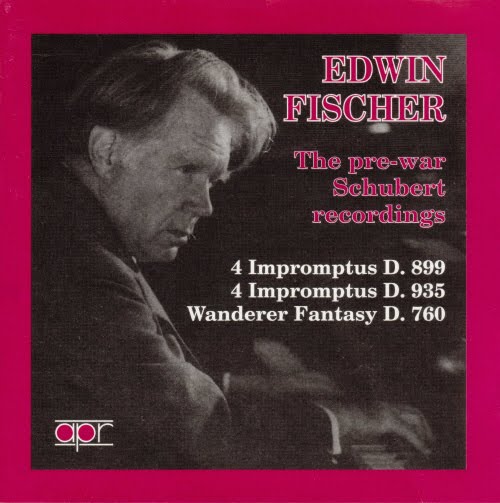
The pre-war Schubert recordings, Edwin Fischer (Impromptus D899 + D935, Wanderer Fantasy D760)

The pre-war Schubert recordings, Edwin Fischer (Impromptus D899 + D935, Wanderer Fantasy D760)
EAC (FLAC, IMG+CUE, LOG) | Complete Scans 300/600 dpi | 1CD, 256 MB + 11 MB (.rar)
Classical | Label: Appian Publications & Recordings APR 5515, United Kingdom 1995 (mono)

It's hard to imagine any living pianist offering Schubert at this level, at least consistently...As for sonics, these transfers strike me as a good compromise between the full-toned but scratchy sound of Pearl and the dull, over-filtered quality typical of EMI...Appian wins handily this time.

A Edwin Fischer has a sense of rhythm which is certainly never a metronomic sense of rhythm. His rhythm is unbridled and his freedom space outlined in phrasing. When listening to this version of the "Impromptus", the feeling that his interpretation is truly modern, almost an objective analysis, is the result of a combination of motricity in rhythm and precision in linking the musical phrases.
Edwin Fischer recorded two sets of Franz Schubert's "Impromptus" op. 90 and op. posth. 142, in a single session, at His Master's Voice studios in London on 8th and 9th March 1938. Certain "Impromptus" required several takes, particularly those in C minor, F minor and A-flat minor. However, Fischer always preferred the first version. All through his life, Fischer defended the conviction that music was at its most beautiful on the first day, a conviction unspoilt even by a few errors, inevitable in producing a record with wax, and which precluded editing. He shared this conviction with Cortot who was often said to like his false notes and with Claudio Arrau, gently nicknamed "Mister take one" by the sound engineers.
Regarding textual accuracy, in Artur Schnabel's recording of the same "Impromptus" in 1950 for the same recording company, an even fluctuating technique is used despite the fact that recording methods had made considerable progress. Moreover, Artur Schnabel is far more prolix in recording (but, in our opinion, far less inspired by this music than Fischer).

Read More...


The pre-war Schubert recordings recorded at Abbey Road, London: 8-9 March 1938 (D899), 8 March 1938 (D935), 22-24 May 1934 (D760)
Transfers made by Bryan Crimp [in a superb sound quality, even better than recordings of the 1950 decade today released on CD by EMI]

01. Impromptus D899 - No 1 in C minor [08:24]
02. Impromptus D899 - No 2 in E flat major [04:18]
03. Impromptus D899 - No 3 in G major [05:05]
04. Impromptus D899 - No 4 in A flat major [07:38]
05. Impromptus D935 - No 1 in F minor [08:31]
06. Impromptus D935 - No 2 in A flat major [04:44]
07. Impromptus D935 - No 3 in B flat major [09:34]
08. Impromptus D935 - No 4 in F minor [05:02]
09. Wandererfantasie D760 - 1 Allegro con fuoco, ma non troppo [05:48]
10. Wandererfantasie D760 - 2 Adagio [06:55]
11. Wandererfantasie D760 - 3 Presto [04:21]
12. Wandererfantasie D760 - 4 Allegro [03:05]

  • Digg
  • Del.icio.us
  • StumbleUpon
  • Reddit
  • RSS

Gubaidulina - Alleluia; Górecki - Miserere - Op. 44 (Danish Nanional Radio Choir and Symph. Orchestra - D.Kitaenko)

Gubaidulina - Alleluia; Górecki - Miserere - Op. 44 (Danish Nanional Radio Choir and Symph. Orchestra - D.Kitaenko)
EAC Rip | FLAC+CUE+LOG | Covers + Booklet | 345 MB
20th/21st Century Classical - Contemporary | 1997 | Chandos

Sofia Gubaidulina (b. 1931), growing up in the Tatar Republic, bound peculiar fusion of Eastern and Western into dramatic polarities in her later work. She graduated from the Kazan' Conservatory in 1954 having studied composition and piano; she then left for Moscow, where she studied at the Conservatory with Nikolay Peyko until 1959, and then with Shebalin until 1963. Already by this time, Gubaidulina was marked as an "irresponsible" composer on "a mistaken path"; Shostakovich, among others, supported her however, advising her to "continue along [her] mistaken path." Today Gubaidulina is a successful freelance composer, having won a number of prestigious composition prizes and grants.
On this CD also the Miserere by the Polish composer Górecki.

Read More...


Tracklist

01. Sofia Gubaidulina - Alleluia - I Alliluija, quarter note = 100 - [0:06:33.02]
02. Gubaidulina - II quarter note = 60, legato simile - [0:02:39.04]
03. Gubaidulina - III Alliluija: quarter note = 144, con spirito - [0:05:31.02]
04. Gubaidulina - IV Alliluija: legato simile - [0:05:29.50]
05. Gubaidulina - V Alliluija: quarter note = 84-88 - [0:02:53.42]
06. Gubaidulina - VI Vjeruju: quarter note = 60-66 - [0:06:46.84]
07. Gubaidulina - VII Da ispolnjatsja usta maja: quarter note = 100-92 [0:05:56.80]
08. Henryk Górecki - Miserere - Domine Deus noster: Lento, Imporingly [0:02:50.02]
09. Górecki - Miserere - Domine Deus noster: Lento, Imploringly, dolce cantabile [0:02:08.44]
10. Górecki - Miserere - Domine Deus noster: Lento, Imploringly, poco espressivo [0:02:24.53]
11. Górecki - Miserere - Domine Deus noster: Lento, Imploringly, molto espressivo [0:02:33.13]
12. Górecki - Miserere - Domine Deus noster: Meno mosso, lento molto tranquillo, Imploringly, tenderly [0:04:09.16]
13. Górecki - Miserere - Domine Deus noster: Molto lento - Poco più mosso ma lento assai, Imploringly, somewhat plaintively [0:05:05.13]
14. Górecki - Miserere - Domine Deus noster: Molto lento - Lento maestoso [0:03:08.57]
15. Górecki - Miserere - Domine Deus noster: Lento, Imploringly, affettuoso [0:01:30.16]
16. Górecki - Miserere - Domine Deus noster: Poco più mosso, lento moderato, molto espressivo, molto appassionato [0:04:05.57]
17. Górecki - Miserere - Domine Deus noster: Lento [0:03:03.73]
18. Górecki - Miserere - Miserere nobis: Lento, tranquillissimo, cantabilissimo, dolcissimo, IMPLORINGLY [0:03:07.86]


  • Digg
  • Del.icio.us
  • StumbleUpon
  • Reddit
  • RSS

Bernstein - Shostakovich: Symphonies No. 6 & 9 [DVD9]

Bernstein - Shostakovich: Symphonies No. 6 & 9 [DVD9]
Classical | DVD | with complete scans (covers and book) | 7,70 Gb (DVD9) | DVD´s FULL No compression
Audio: PCM Stereo | DTS 5.1

This DVD is a fascinating document of a great conductor and orchestra playing two of the most underrated of Shostakovich's symphonies in 1985 and 1986 concerts in Vienna's Musikverein. In his spoken preface to the Sixth Symphony, Bernstein says he wants to "right a wrong"--the "wrong" being the work's reputation as unstructured lightweight piece. It is an unbalanced work, the opening Largo much longer than the remaining two movements, which can seem as mere appendages. But even at his extremely slow tempo, Bernstein makes it all hang together--the Largo moving in its icy bleakness, the Scherzo a genial joke, the final Presto (taken more as an Allegro and not a fast one at that) an opportunity for the conductor to show off his dance steps. The Haydnesque Ninth, despite idiosyncratically slow tempos is light and humorous, its sardonic touches here relished by Bernstein.
The Vienna Philharmonic isn't the ideal band for Shostakovich but Bernstein makes them play beyond their natural inclinations; here they lack only a bit more vulgarity in the brass and percussion to be fully idiomatic. The net result is a pair of deeply felt, emotionally powerful performances. Director Humphrey Burton's discreet camera work is excellent, with sufficient close-ups of the conductor and plenty of section shots interwoven with close-ups of solo players to help draw attention to key musical strands.
Extras include Bernstein's cogent spoken prefaces to the works.

Read More...


Track Listing:


Symphony No. 6 in B minor Op. 54
1. Opening Credits
2. I. Largo
3. II. Allegro
4. III Presto

Symphony No. 9 in E flat majot, op. 70
5. Opening Credits
6. I. Allegro
7. II. Moderato
8. III. Presto
9. IV. Largo
10. V. Allegretto

BONUS
Introductions by Leonard Bernstein
Symphony No. 6
Symphony No. 9


  • Digg
  • Del.icio.us
  • StumbleUpon
  • Reddit
  • RSS

Beethoven - Last Sonatas op. 110 & 111 - Youra Guller

Beethoven - Last Sonatas op. 110 & 111 - Youra Guller
EAC (FLAC, IMG+CUE, LOG) | Complete Scans 300/600 dpi | 1CD, 201 MB + 18,9 MB (.rar)
Classical | Label: Erato/Warner 98527, Germany 1995

Madame Youra Guller is one of the race of interpretative artists made for this type of work. She became known, between the two wars, as one of the great contemporary pianists. But she has never consented to become one of the celebrated idols woh travel continually around the world playing the same programme to the public. As a meticulous, modest, refined and almosts mystical pianist, each of her appearances on the concert platform has impressed her audience by the intensity of her performance and the nobility of her style. It is fitting that this record bears withness to such an artist in the recording of these two sonatas, in which she conveys all the solemn, profound, magical beauty in a personal rendering which has the mark of authenticity, as much in its conception as in its supreme execution.

Again, the playing is of the utmost profundity, among the greatest Beethoven interpretations ever recorded.

Read More...


Ludwig van Beethoven - Piano Sonatas op. 110 & op. 111
Recorded on 13th February 1973 at Église du Liban, Paris

01. No 31 in A flat - 1. Moderato cantabile, molto espressivo [06:49]
02. No 31 in A flat - 2. Allegro molto [2:30]
03. No 31 in A flat - 3. Adagio, ma non troppo [3:33]
04. No 31 in A flat - 4. Fuga: Allegro, ma non troppo [7:59]
05. No 32 in C minor - 1. Maestoso. Allegro con brio ed appassionato [10:27]
06. No 32 in C minor - 2. Arietta. Adagio molto, semplice e cantabile [18:35]


  • Digg
  • Del.icio.us
  • StumbleUpon
  • Reddit
  • RSS